
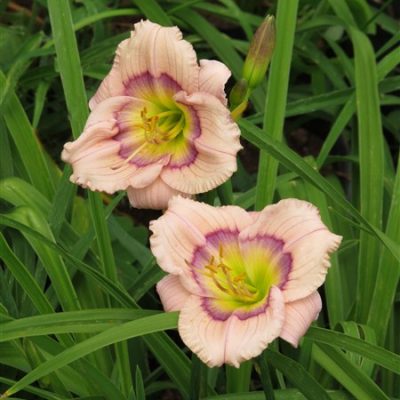
The ‘Siloam David Kirchhoff’ daylily (botanically known as Hemerocallis ‘Siloam David Kirchhoff’) is a highly acclaimed, compact, small-flowered daylily cultivar that is prized by gardeners for its vibrant colour contrast and prolific bloom habit. Bred by renowned daylily hybridizer Pauline Henry in Arkansas (1986), it is a cornerstone of the famous “Siloam” line of daylilies. [1, 2, 3, 4]
Here is the essential breakdown of the plant’s features:
- Flower Details: Features a small, 3.5-inch (8.9 cm) orchid-pink or light lavender flower. It has a highly contrasting, sharply defined purple-red or cerise eyezone and a bright, star-like yellow-green throat. [1, 2, 3, 4, 5]
- Plant Size: A true dwarf/miniature variety. The foliage clump typically reaches about 12 inches (30 cm) tall, with sturdy flower stems (scapes) rising just slightly above, reaching a mature height of roughly 16 to 18 inches (40-45 cm). [1, 2, 3, 4]
- Bloom Time: Blooms early to midseason, typically emerging in June and continuing into July. [1, 2]
- Foliage Habit: It is a dormant, diploid variety. The grass-like green foliage dies back completely in the winter and re-emerges in the spring. [1, 2, 3]
- Hardiness: Extremely hardy, thriving across USDA hardiness zones 3 to 9 (surviving temperatures as low as -40°F). [1]
Ideal Landscape Uses
Due to its diminutive size, this daylily is not meant to be hidden at the back of a border. Instead, it is highly recommended for: [1]
- Border Edging: Excellent for lining walkways and garden beds.
- Container Gardening: Its compact stature makes it a perfect candidate for patio pots, balconies, and mixed planters.
- Rock Gardens: Highly effective when grown in smaller, manicured spaces or rockery mounds. [1, 2, 3, 4]
Care and Cultivation
Daylilies are widely known as “perfect perennials” for their tough, low-maintenance nature. For ‘Siloam David Kirchhoff’, keep these cultivation points in mind: [1]
- Sunlight: Thrives in full sun to partial shade (4 to 5 hours of direct sunlight daily is ideal).
- Soil: Adapts to nearly any soil type, but prefers deep, fertile, humus-rich loam that is well-drained.
- Watering: Drought-tolerant once established, though it performs best when given about an inch of water per week during its growing season.
- Maintenance: Deadhead faded flowers daily for a tidy look, and cut back the entire flowering stem once all blooms have finished.
- Division: To maintain vigor, divide the clumps every 3 to 4 years, ideally in the fall after the blooming season. [1, 2, 3, 4]